Last updated: May 2026 · Author: Darja Pilz, connactz
Quick Answer: A live band and a DJ deliver different experiences. A band brings physical energy, brass sound, stage presence and spontaneous interaction with the dance floor, starting at 800 euros for a duo and reaching up to 5,800 euros for a big band. A DJ costs 400 to 1,200 euros, covers any genre seamlessly and plays through the entire night. Book a band for emotional live moments and a multi-generational crowd. Book a DJ for seamless dance-floor power and tight budgets. If you want both, combine a band for 2 to 3 sets with a DJ for breaks and after-party.
What makes a live band and a DJ different?
The choice between live band and DJ is rarely a style question and more often a question of desired energy and budget. Both options entertain weddings, corporate events, galas and private parties at professional level, but they do it in different ways.
Live band: energy, show, interaction
A live band brings physical presence to the stage. You see musicians with instruments, you hear a real brass section or acoustic guitar, and you feel how a singer reacts directly to the room. With soul, jazz, funk and pop cover bands, you get this energy combined with concrete repertoire versatility.
DJ: seamless genre variety and continuous flow
A DJ plays from a library of tens of thousands of tracks. Genre switches happen in seconds, transitions are seamless, and the dance floor stays in continuous motion. A good DJ reads the audience just like a good band does, only with a different tool.
Takeaway: A band is show plus live energy. A DJ is seamless flexibility plus full genre breadth. Both can entertain at professional level.
Live band vs. DJ in direct comparison
This table shows the key differences from the event host's perspective. It helps with the initial choice but does not replace a real audio sample on the artist profile.
Criterion | Live band | DJ |
|---|---|---|
Typical fee 2026 | 800 to 5,800 euros | 400 to 1,200 euros |
Setup time | 2 to 4 hours incl. soundcheck | 60 to 90 minutes |
Stage space needed | 6 to 50 sqm (depends on line-up) | 3 to 6 sqm |
Repertoire | 50 to 200 songs, curated | 10,000-plus tracks, on demand |
Performance duration | 2 to 3 sets of 45 to 60 min | 4 to 8 hours continuous |
Breaks | 20 to 30 min between sets | none |
Audience interaction | high, visible stage presence | moderate, mostly via mic |
Genre switching | limited to rehearsed repertoire | seamless in seconds |
Show element | strong visual, photogenic | minimal, focus on sound |
Which event type fits which choice?
Larger events split into mood slots. Some slots clearly belong to one option, others combine both.
Wedding
A mix works best in most cases: a soul or jazz band for reception and the dance opening, then a DJ for the after-party phase. If your budget allows only one option, lean towards a band for a classic wedding picture, and towards a DJ for a young urban wedding. Our Soul vs. Funk vs. R&B comparison (DE) shows which band styles fit which wedding moment.
Corporate event and gala
Professional representation is the priority. For a classic black-tie gala, a jazz or swing big band is hard to beat. For a tech or startup corporate event with a younger audience, a DJ often hits the taste more precisely. Concrete acts for corporate events are in our Top 10 Jazz bands for corporate events (DE).
Birthday and private party
Generation mix dominates. A versatile cover band with mixed lead vocals (male and female) serves all age groups. If budget is tight: DJ. For themed parties (80s party, vintage wedding) a specialized band pays off because it carries the visual concept.
Open-air and summer festival
Outdoors, acoustic projection matters. A brass section projects better outdoors than an acoustic duo. A DJ needs a solid PA, otherwise the bass disappears in the wind. Both work outdoors, but technical preparation is mandatory.
Takeaway: For the majority of weddings, a band-plus-DJ combination is the most professional solution. When only one choice is possible, the answer depends on budget and the mood profile of your audience.
When is a DJ the smarter choice than a band?
Despite all the live energy, a DJ is the more rational decision in three specific scenarios. An honest trade-off analysis so you don't overpay out of romanticism.
Tight budget and maximum playing time
A band typically plays 2 to 3 sets of 45 to 60 minutes, so 2 to 3 hours of net playing time per evening. A DJ plays continuously for 4 to 8 hours. Per euro you get significantly more playing time with the DJ. On a 1,200-euro budget you get a full evening with the DJ, but only 2 sets with a band.
Young urban audience and genre depth
For guests aged 25 to 40 with a preference for current charts, house or hip-hop, a DJ covers the genre breadth that a cover band can never match. A good DJ delivers 60s classics one moment and a fresh top-40 track 60 seconds later. According to the Wikipedia definition of disc jockey, genre bridging is exactly the core function.
Small venue or tight schedule
If your venue only has 3 to 6 square meters of stage or you can only offer a 30-minute soundcheck window after the ceremony, a live band is logistically problematic. A DJ needs less space, less power and less setup time. The Wikipedia history of the concert shows how live performance setups have evolved technically since the 18th century. Today, setup logistics are the decisive operational difference between a band and a DJ.
How to find a band or DJ on connactz
Over 800 bands and several hundred DJs are listed in the directory. You can browse the band directory or the DJ directory yourself, or create a free open call. The AI matching delivers 5 to 10 suitable offers within 1 to 2 hours, both bands and DJs, which you compare transparently. Your budget stays confidential, connactz takes no commission on the fee. If you want the band-plus-DJ combination, you can request both in the same open call.
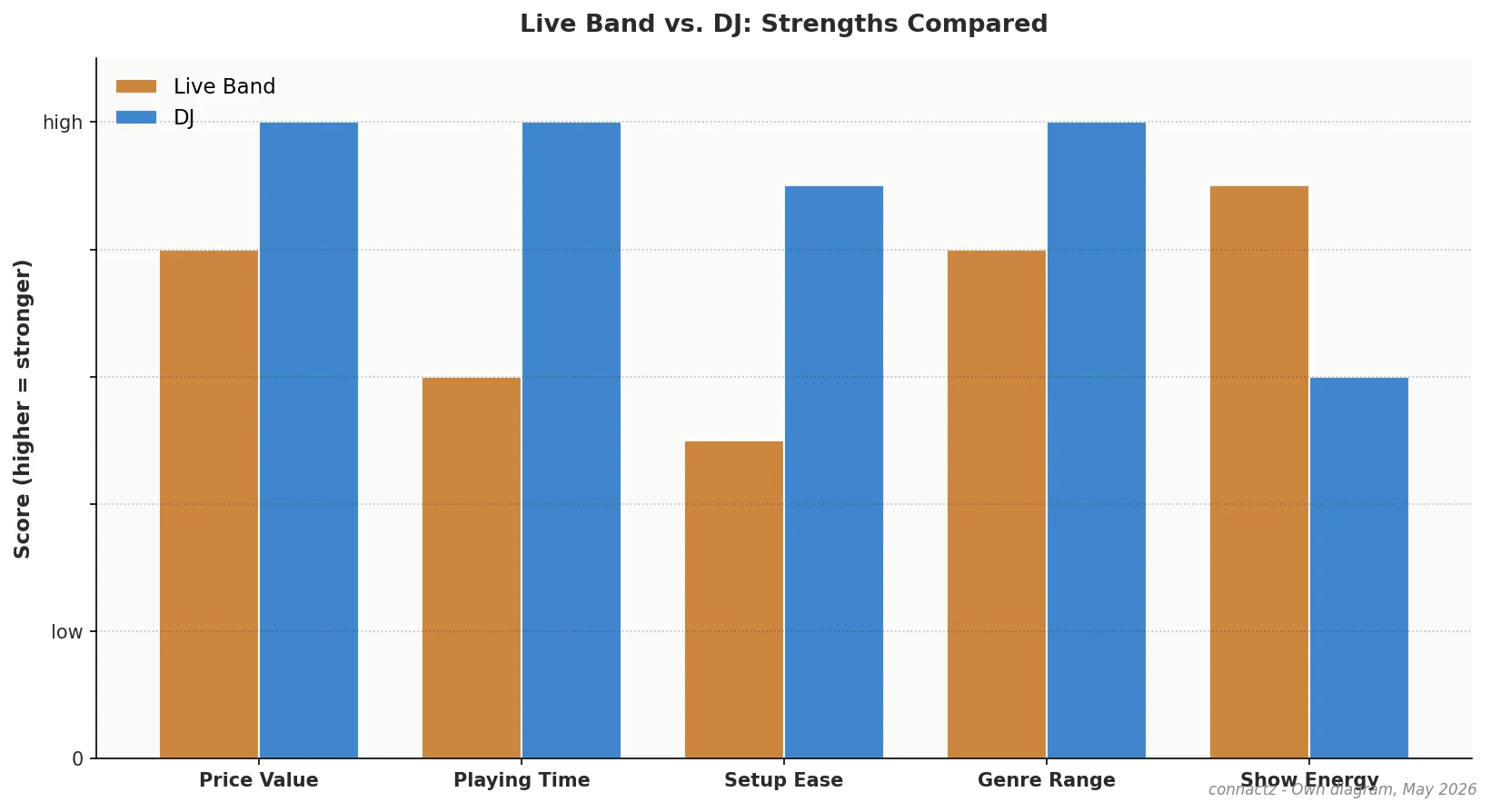
Own diagram: Live band and DJ compared by fee, playing time and event-phase suitability.
👉 Related: How to book a band: step-by-step
Find a band or DJ

